
ChatGTP Ads – what UK ecommerce brands need to know
ChatGPT Ads are now available in the UK, both for people seeing ads in ChatGPT and for UK businesses wanting to advertise. And I think this could be particularly interesting for ecommerce brands.
Not because I think everyone should immediately abandon Meta or Google and start throwing money at another advertising platform, but because the way ChatGPT decides which ads to show is quite different.
And, importantly, it puts a lot of emphasis on something I talk about all the time: knowing your customer and getting your messaging right.
So, how do ChatGPT Ads work?
Let’s look at it from the customer’s point of view first. Imagine someone types this into ChatGPT:
“I need a present for my sister’s 40th birthday. She loves jewellery but I don’t want anything too obvious or mass-produced. I’ve got around £50 to spend.”
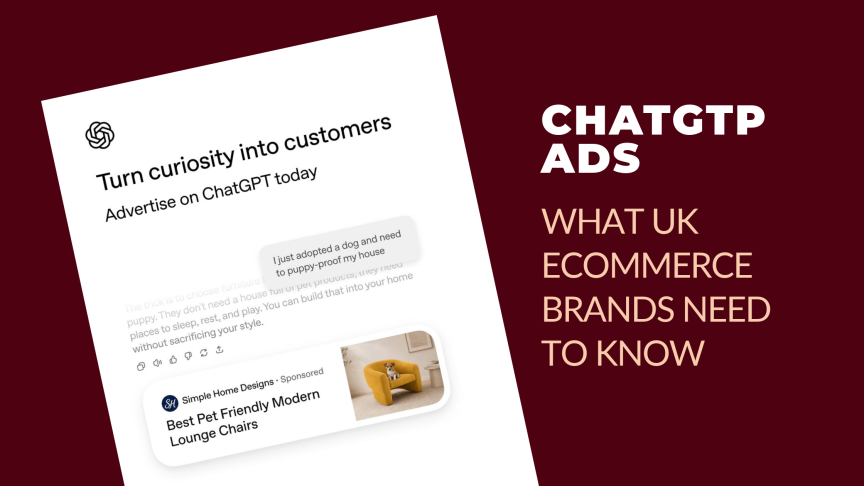
ChatGPT answers their question as normal. Then, underneath that answer, they might see a clearly labelled sponsored ad from a jewellery retailer whose products are relevant to that conversation. The ad can include the business name and logo, a headline, description, image and a link through to the website.
The important bit is that the advertiser hasn’t paid ChatGPT to recommend them in the actual answer. The answer and the ad are separate. The advertiser is paying for the opportunity to appear alongside a conversation where their product could be relevant.
And that’s the bit I find really interesting.
It’s a little bit like Google Ads… but better at understanding intent
With Google Search Ads, we tend to think in terms of keywords and short phrases.
For example:
“40th birthday jewellery”
“unusual gift for mum”
“handmade jewellery UK”
“bracelet under £50”
Someone searches using words connected with your product and your ad may appear (if you’ve specified those keywords and terms).
ChatGPT Ads go further than that. Instead of only thinking about the exact words someone types, ChatGPT can look at the meaning of the conversation and what that person appears to be trying to achieve.
Advertisers can also give the system something called context hints.
These help explain the kinds of conversations where an advert might be relevant.
So instead of simply targeting “handmade bracelet“, you can start thinking more like “Someone looking for an unusual milestone birthday present for a woman who likes jewellery but doesn’t want something mass-produced“. Or “Someone who wants a special jewellery gift but has a budget of around £50“.
That feels quite different.
Google is about “What did they search for?”, ChatGPT can get closer to “Why are they searching in the first place?”.
That doesn’t mean that ChatGPT Ads will perform better than Google Ads. But it does give advertisers a more comprehensive way of thinking about customer intent.
And it’s quite different from Meta too
Meta advertising has been moving more and more towards letting its own systems decide who is most likely to respond to an ad. Creative has become an increasingly important part of that. The creative stops someone scrolling and makes them pay attention before they even think about reading the copy.
Meta itself now puts a lot of emphasis on creative variation, images, video and using different creative assets to help it find the right audience. I wouldn’t say that the image matters more than the copy, but Meta advertising has definitely become much more creative-led.
With ChatGPT Ads, I think the balance is slightly different. The image still matters. It still has to attract attention and make the product appealing. But the words, the context and the meaning behind them are doing a lot of the work in helping ChatGPT understand who to show your ad to.
So, my way of thinking about it is this:
Meta: creative helps attract the right person.
Google: keywords help identify what someone is searching for.
ChatGPT: words and context help identify what someone is actually trying to achieve.
That could make good messaging incredibly valuable. It’s something that’s at the core of my programme, Elevate, which you can check out here.
What does an ecommerce brand need to set up?
The advertising platform is called OpenAI Ads Manager. If you’ve used Meta Ads Manager or Google Ads, the general structure will feel similar.
You create a campaign, choose your objective, set a budget and targeting, then create ad groups and the individual ads within them. The current minimum campaign budget in the UK is £15 per day, although I’d always check the latest requirements before launching because that could change.
For a simple test, that means a small ecommerce business could potentially run something like:
£15 per day for 14 days = £210.
That’s still enough money to require a properly thought out plan behind it, but it does make the platform accessible to smaller brands.
Then you create your ad groups
This is where you need that proper plan – don’t rush it.
Don’t just create Skincare or Jewellery and put everything into one group. Think about the different reasons people buy.
For example, a skincare brand might have:
Dry skin – someone looking for help with very dry or uncomfortable skin.
Gifting – someone looking for a lovely skincare present for their mum, friend or relative.
Natural skincare – someone researching alternatives to the skincare products they already use.
Each of those situations could have different context hints, different copy and a different landing page (or product). That makes the advertising much more relevant.
What does the actual ad contain?
A standard ChatGPT ad can contain:
- a headline
- a description
- an image
- a landing page
You could use a product image, a lifestyle image, a styled image or other suitable creative. But I wouldn’t start with the image. I’d start with:
Who is this person?
What do they want?
Why do they want it?
What problem are they trying to solve?
What might stop them buying?
Then build the ad around that. This kind of thinking is must to my ears (or is it eyes?) as I’m passionate about retailers using better messaging that resonates with their audience in all their marketing.
There’s also an option for a product-feed which starts to make ChatGPT advertising feel a little closer to Google Shopping or Meta catalogue ads. Retailers can supply product information such as images, prices and landing pages and use that information in product-based ads.
You can track sales too
You can use conversion tracking to measure actions like purchases from your ads in a similar way to Meta and Google Ads. That means an ecommerce business can look beyond “how many people saw the ad?” and start asking the much more useful question – “Did it actually generate sales?” which is the ultimate goal.
Before you consider starting…
Before you start worrying about campaigns, ad groups or images, there’s something else far more important you need first.
Your messaging.
In order to create good context hints, you need to understand things like:
- What problem is your customer really trying to solve?
- What’s happening in their life when they start looking for your product?
- What questions or concerns might stop them buying?
- What do they want to happen after they buy?
- What makes your product or business different?
- What words would they use to describe all of this?
If you don’t know those things, ChatGPT Ads is just another place to spend money without really knowing what you’re trying to say.
Which brings me rather neatly to Elevate
Elevate is my Ecommerce Growth Programme for product based businesses who want to build more consistent sales, with a clearer strategy, practical support and all the key pieces working together.
The very first module inside Elevate is the Relatable Message Matrix, and there’s a reason we start there.
Before we get into content, email marketing, traffic acquisition, conversion and everything else, we work on understanding your customer properly and getting your messaging right.
The Relatable Message Matrix helps you identify things like:
- the deeper problems your customers are dealing with
- the questions and concerns that might stop them buying
- the result they really want
- what’s different about you, your products or the way you sell them
In Elevate, we use that work to improve emails, social content, website copy, product messaging and offers, but now there’s another very obvious use for it.
ChatGPT Ads.
Because if this advertising channel continues developing as it is, and if perhaps other AI tools go the same way (very likely), the businesses that really understand why people buy from them are going to be in better place and more able to use it as they’ll already have what they need for their context hints, ad groups and copy.
Messaging is just the start
Of course, getting your messaging right is only the beginning. Inside Elevate, we work through the other areas you need to grow a stronger ecommerce business too, including your numbers, your marketing plan, content, email automations, acquisition, retention, conversion optimisation and increasing the value of the customers you already have.
There’s very little point using ads (on any platform) and paying to send more people to your website if the messaging isn’t clear, the website doesn’t convert, and there’s a weak email strategy in place.
ChatGPT Ads could become a really useful acquisition channel but the businesses that get the most from it will still need the foundations underneath it.
Want to build those foundations properly? Take a look at Elevate and book a free call to chat it over here.
Explore more articles


Share this Post